


Game of Sky
IGG.COM
I approached Game of Sky as a decision rather than a quick download: does a strategy game built around airships, giant creatures, and a kingdom in the sky offer enough depth to earn a place on a phone? After spending time with it, my answer is yes for players who enjoy a fantasy setting wrapped around gradual progression, but with an important qualification. This is not the best match for someone who wants a compact puzzle session, a purely tactical battle game, or a strategy experience with no pressure from optional spending.
Developed by IGG.COM, this free strategy game combines aerial adventure with the longer rhythm of building and improving a realm. Its Teen content rating is worth noticing before installation, especially for younger players and families. The game is available for devices running Android 5.1 or later, and the current version is 3.9.3. Those details make it accessible to a broad range of phones, although the experience will still feel more comfortable on a device with a reasonably sized screen and enough spare storage for updates.
What to consider before choosing Game of Sky
The first question is whether you like strategy games that ask you to return repeatedly rather than finish in one sitting. Game of Sky is built around the appeal of managing a floating domain while sending an airship into danger. That combination gives each session two different moods: planning and improvement in the kingdom, followed by action-oriented encounters against enormous beasts. I found that contrast more interesting than a game that stays entirely inside menus or relies only on battles.
The second question is how much patience you have for progression. A sky kingdom does not become impressive immediately. Early decisions are usually about learning the interface, understanding which improvements matter first, and making sensible use of whatever resources are available. That slower opening is useful because it gives the setting time to settle in, but it may frustrate players who expect a dramatic battle every time they open the app.
I also paid attention to how well the two sides of the game support each other. The airship is not just a visual theme, and the kingdom is not merely a background. The appeal comes from moving between preparation and adventure: improve your position, take on a threat, then use the results to continue developing. The strongest reason to try it is this loop between aerial exploration, monster encounters, and kingdom growth. If one part of that loop does not interest you, the overall experience loses much of its pull.
Related News






The public response is mixed but substantial enough to show that the game has found an audience. It holds an average rating of 3.7 from around 3.4 thousand ratings, with about 182 written reviews and over 100 thousand installs. I would read those figures as a reason to approach it with realistic expectations rather than as a simple recommendation or warning. The game clearly appeals to some strategy fans, while the middling average suggests that its pacing, monetization, or style will not suit everyone.
How the main loop feels in everyday play
In a normal session, I would begin by checking the kingdom and deciding what deserved attention first. That simple habit prevents the game from turning into random tapping. Instead of improving everything as soon as it becomes available, I preferred to choose a short-term goal, such as preparing for the next expedition or strengthening the part of the settlement that supported my current bottleneck. This approach made the progression feel more deliberate and reduced the sense of being pulled in several directions.
The airship gives the game its clearest identity. Flying toward colossal beasts creates a stronger sense of purpose than ordinary resource collection, because there is a visible threat waiting at the end of the preparation. I liked treating each outing as a small decision: should I push forward, or spend more time improving the kingdom first? That trade-off is more interesting than simply selecting the most powerful available option.
Gallery
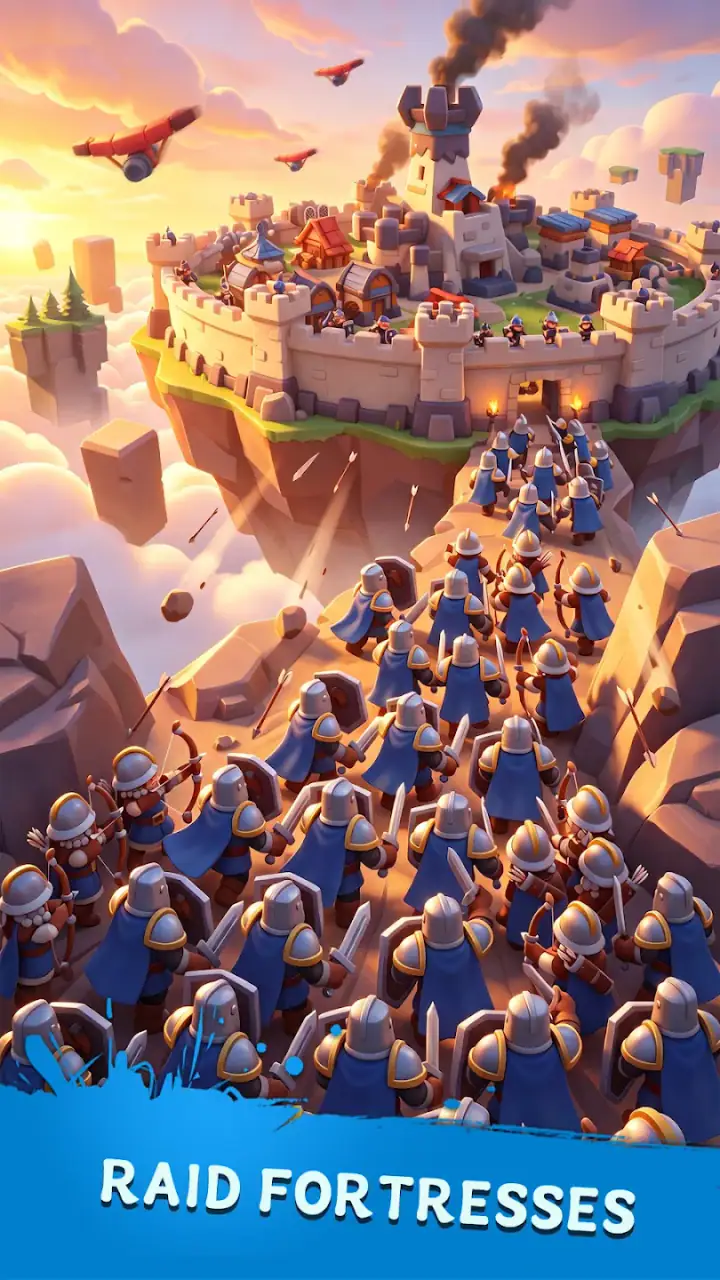
A realistic use case is a short break during a commute or lunch. I could open the game, review the kingdom, make one or two improvements, and decide whether an airship attempt made sense before closing it again. A longer evening session works differently: I could focus on several connected objectives and enjoy the fantasy atmosphere more fully. The game therefore suits players who like returning to an ongoing world, although it is less satisfying if you only want a complete experience in five minutes with no unfinished plans waiting for you.
Three habits that make the experience smoother
My first practical tip is to avoid spending resources simply because an upgrade is available. The game presents a kingdom that can easily tempt you into constant improvement, but a scattered approach makes progress feel slower. I got better results by deciding whether my next priority was survival, stronger expeditions, or general development, then directing resources toward that purpose. This is a small change in routine, but it gives the strategy layer more meaning.
Second, I would not treat every encounter with a giant beast as a test that must be attempted immediately. If the airship side starts to feel punishing, returning to the kingdom and improving your preparation can be more rewarding than repeating the same attempt without changing anything. That makes failure useful: it tells you whether your current problem is a lack of strength, poor timing, or an upgrade path that needs attention.
Third, I recommend separating “progress” from “entertainment” when planning sessions. Kingdom management is the part that keeps the account moving, while airship expeditions provide the more memorable moments. If I opened the game only to collect or upgrade, it could feel routine. If I opened it only for combat, I would miss the system that makes each expedition matter. Alternating those activities helped the game feel less repetitive.
Where this game is genuinely strong
Game of Sky wins when a player wants a recognizable strategy foundation with a more unusual setting. Many mobile strategy games place their action in familiar medieval landscapes or military environments. Here, the floating kingdom and airship give the progression a distinct visual and thematic direction. I found that the fantasy of preparing a settlement above the world, then sending an airship toward a huge creature, is more motivating than another anonymous upgrade menu.
It also benefits from having a clear reason for development. Building is not presented as an isolated decorating activity; it supports the larger ambition of surviving and overcoming threats in the sky. That connection is important for players who need a narrative excuse to keep improving numbers and structures. Even when the individual task is routine, the broader goal remains easy to understand.
Another strength is flexibility of attention. You can approach it as a builder who enjoys gradual kingdom growth, as an adventure fan attracted by the airship, or as a strategy player who likes deciding when to prepare and when to take a risk. It does not become three separate games, but the balance lets different types of players find an entry point. In my experience, that is more valuable than having a large number of unrelated modes.
The game is also free to start, which lowers the barrier for anyone curious about its unusual premise. That matters because the concept is specific enough that you may not know whether it fits your taste until you have tried the loop yourself. I would install it for the setting and basic structure, then decide whether the pacing justifies continued play rather than committing based only on the store summary.
Limits that should influence your decision
The first limitation is the possibility of friction in the progression. A free strategy game with long-term development naturally asks for patience, and Game of Sky is not designed like a self-contained premium title. If you dislike waiting, repeated improvement tasks, or the feeling that your next goal is tied to gradual accumulation, the sky setting will not solve that underlying issue.
Optional purchases are another serious consideration. The game is free, but its in-app purchases range from $0.99 to $299.99 per item. That range does not automatically make the game bad, yet it means I would approach spending carefully. The safest habit is to decide on a personal limit before becoming invested in the kingdom. Otherwise, the desire to complete an upgrade or overcome a difficult encounter can make a small purchase feel easier than it should.
I would also be cautious about recommending it to children simply because it is colorful or fantasy-themed. The Teen rating is a clearer guide than the artwork alone. Parents should consider whether the strategy loop, combat against colossal creatures, and optional purchases fit the player’s age and household rules. For adults, the rating is less of a concern, but it still signals that this is not necessarily a gentle, all-ages building toy.
The mixed rating suggests another trade-off: the game’s appeal depends heavily on tolerance for its particular pace and structure. Players who want precise, competitive tactical control may find the kingdom layer too involved. Players who want a relaxed city builder may find the beast encounters too prominent. It works best in the middle, where planning and fantasy adventure reinforce each other.
How it compares with other strategy choices
Compared with a traditional city-building game, Game of Sky offers a stronger adventure hook. A conventional builder may be better if your main pleasure comes from arranging a settlement, optimizing production, or watching a town expand without frequent combat pressure. I would choose that alternative for a calmer, more management-focused experience. Game of Sky is the better choice when the settlement needs to lead somewhere, particularly toward airship expeditions and confrontations with oversized enemies.
Compared with a pure tactical battle game, this title gives up some immediacy in exchange for a broader sense of ownership. A battle-focused alternative may be preferable if you want every minute to revolve around positioning, timing, and direct decisions during combat. Here, the kingdom and the preparation around an expedition are equally important. That makes the game less suitable for someone who thinks everything outside the battle is an interruption.
Compared with a casual puzzle game, the difference is even clearer. Puzzle games usually reward quick focus and provide a clean stopping point. Game of Sky asks you to remember an ongoing set of goals and return to them later. I would recommend the puzzle alternative to a player who wants low commitment and immediate completion. I would recommend this game to someone who enjoys leaving a larger project in progress and checking how it develops over time.
There is also a difference from premium strategy games. A paid game may offer a more predictable cost and a tighter, self-contained design, while this free title lets you sample its central idea before deciding whether to invest time or money. The trade-off is that the free-to-play structure can influence how progression feels. For me, the free entry point is useful, but it does not remove the need for discipline around purchases.
Who should install it, and who should skip it
I would recommend Game of Sky to a player who likes fantasy strategy, enjoys building toward a goal, and does not mind returning to the same world over multiple sessions. It is particularly suitable if the idea of an airship expedition sounds more exciting than another ordinary map campaign. Players who enjoy balancing preparation with risk will probably get the most from it.
I would skip it if you want a story-driven game that can be completed in a weekend, a minimalist game with almost no menus, or a competitive title where skill in each individual battle is the only thing that matters. I would also skip it if optional purchases make free-to-play progression stressful for you. No amount of interest in floating kingdoms is worth turning a leisure activity into a source of frustration.
For families, I would make the decision with both the Teen rating and the purchase structure in mind. For older players, the more important question is whether the long-term loop feels satisfying. If you enjoy maintaining a project and gradually improving your options, the game has a reasonable chance of becoming a regular part of your routine. If you need constant novelty, its repeated development cycle may wear thin.
The real cost of switching from another strategy game
Moving from another mobile strategy game is not just a matter of installing a new app. You are also switching the kind of attention the game demands. If you are used to direct battles, you will need to accept more preparation. If you are used to builders, you will need to engage with threats and expeditions. The adjustment is worthwhile only if the airship theme adds something you have been missing.
I would test the game during a week when I could play without rushing. That gives enough time to see whether the kingdom loop feels purposeful or merely repetitive. I would also avoid making purchases during the first sessions. Learn how the progression feels naturally, then decide whether the convenience of spending is actually valuable to you. This is especially important because the highest listed purchase reaches $299.99, a level that deserves deliberate consideration rather than an impulsive tap.
The current version, 3.9.3, is the one I would look for when checking that the installation is up to date. Since the game is free and supports Android 5.1 or later, trying it is relatively simple for compatible users. The bigger investment is not the download; it is the time spent learning the kingdom, understanding the airship routine, and deciding whether the long-term goals are enjoyable enough to continue.
My recommendation after weighing the trade-offs
I recommend Game of Sky with conditions rather than giving it an automatic yes. Its best idea is the connection between a floating kingdom and airship-led encounters with colossal beasts. That gives the strategy category a distinctive fantasy identity and offers a satisfying reason to keep developing. I enjoyed it most when I treated each improvement as preparation for a future expedition instead of as an isolated task.
At the same time, the game is not a universal recommendation. The 3.7 average rating reflects a product with clear appeal but also clear friction. The free-to-play format, gradual progression, Teen rating, and broad in-app purchase range all matter when deciding whether it belongs on your phone. I would start without spending, establish a personal limit, and judge the game by how enjoyable the loop remains after the initial novelty fades.
My final verdict: choose it if you want a long-running fantasy strategy game where kingdom management leads into airship adventure; choose something else if you want instant battles, a quiet builder, or a fixed-price experience. For the right player, Game of Sky feels distinctive enough to be worth trying. For everyone else, the unusual setting cannot compensate for a progression style that may demand more patience and restraint than they want to give.
FAQs for Game of Sky
What is Game of Sky about?
Game of Sky is a fantasy strategy game that combines city building, resource management, hero development, and real-time or asynchronous battles. You create and improve a floating kingdom, recruit powerful characters, research upgrades, and expand your influence across a magical world. Progress usually involves completing quests, participating in events, joining alliances, and making strategic decisions about armies and resources.
Is Game of Sky free to download and play?
Yes, Game of Sky can generally be downloaded and played for free on supported Android and iOS devices. However, it may include optional in-app purchases for premium currency, resource bundles, cosmetic items, or progression boosts. You can enjoy the main gameplay without paying, although free players may need more patience when upgrading buildings, training units, or competing with users who spend money.
Does Game of Sky require an internet connection?
Game of Sky is primarily an online game, so a stable internet connection is normally required for logging in, synchronizing progress, joining events, managing alliances, and participating in battles. Offline access is limited or unavailable because much of the game depends on server-based features. Using Wi-Fi or a reliable mobile connection is recommended to prevent interruptions and lost progress.
Is Game of Sky suitable for beginners?
Game of Sky is accessible to beginners because its early missions introduce construction, resource collection, research, hero upgrades, and combat step by step. Nevertheless, the number of menus, currencies, timers, and upgrade systems can feel overwhelming at first. New players should follow the tutorial, complete daily tasks, save premium resources, and join an active alliance to receive advice and helpful rewards.
Does Game of Sky contain purchases or age-related concerns?
Game of Sky may contain optional purchases, advertisements, or promotional offers depending on the version and region. Because strategy games often use premium currencies and limited-time bundles, it is wise to review the payment settings before allowing children to play. The fantasy combat is generally stylized rather than realistic, but parents should still check the official age rating and privacy information.
Pros
- Beautiful fantasy visuals and detailed city-building environments.
- Large-scale battles make progression feel rewarding and strategic.
- Many heroes offer varied team combinations and play styles.
- Regular events provide fresh objectives and additional rewards.
- Alliance features encourage cooperation and social interaction.
Cons
- Progress can feel slow without spending premium currency.
- Combat may become repetitive after extended play sessions.
- Numerous menus and systems can overwhelm new players.
- Strong alliances can create pressure to remain active daily.
- Internet access is required for most gameplay features.


